
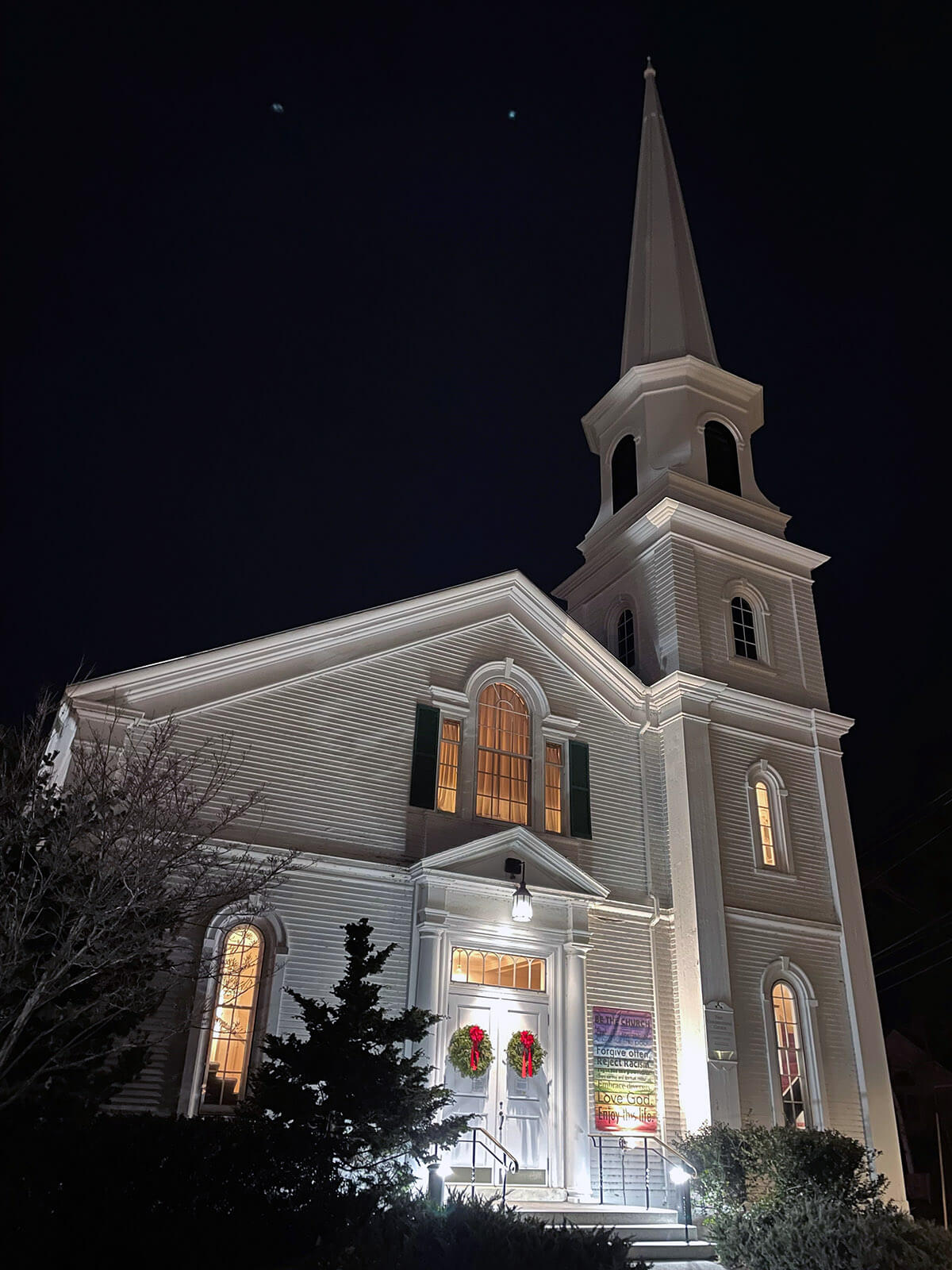
As I mentioned previously, you do not have to be religious or part of any denomination to derive value from the lessons I’ve identified. But I did think you might find it interesting to read a little about the Congregational church in general and its roots in democratic principles. That history is alive and well. What follows is a simplified version of the official history and a little about the specifics of the church in Camden.
Many of you may never have heard of Congregational churches at all. They tend to be clustered in New England, the upper Midwest and Pennsylvania with a smattering throughout the rest of the country. Even if you have driven by a Congregational church you may know very little about them. They tend to be relatively quiet. Church members do not typically proselytize. They will not typically attempt to convert you. Instead, if you choose to join it is of your own choosing alone. For that reason, church members are rarely outside with signs. The church also tends to be apolitical and because the overall church has minimal hierarchy, and each individual church craves its own independence there is some but mostly minimal coordination at the national level. This again speaks to the church being quiet on the political front. For these reasons you may not have heard of the denomination so I thought it might be fun to explore the history a little.
The origins of the congregational church stretch back to the 1500s in England during a time of tumult and reformation. The Church of England had split with the Catholic church. The essential nature of the two churches were the same but the former was controlled by the English king and the latter by the Pope. In each case there was an extensive hierarchy that dictated religious life not only in theological life but also in more mundane matters such as the appointment of local priests. Many people chafed at what they saw as an oppressive and unquestioning regime. In smaller churches the quality of the appointed priests was poor and local populations wanted more control to choose their own priests. They also wanted to exert control over the order of the service and to discipline their own church members in the way they saw fit as opposed to having these things dictated from afar. Similar rumblings were happening throughout Europe, but congregationalism is most directly associated with the protest movement within England.
Adherents of this movement often sought to simplify the church in the areas of service as well as the church organization itself. Services of the Anglican Church of the time were elaborate affairs and the movement sought to focus on the theology rather than the ceremony. The also stressed the role of the laity in the overall organization of the church. This is a central, defining feature of congregationalism today. In modern congregational churches, the laity run the church and the minister serves at the pleasure of the congregation.
In these ways the movement sought to purify the church. They were not necessarily welcomed, however. The term “Puritan” was initially meant as a derogatory term for the movement. The movement was a challenge to the hierarchy of the Church of England and as the King ruled the church they were viewed as a challenge to the King as well. The early movement was hence deemed illegal and early adherents were jailed, hanged, or forced to flee. This was a time of experimentation. Early congregations, fearing persecution, would meet in people’s homes. Hence an early sense of independence was developed.
While they would share information, books, and a common, simplified version of the Christian theology they were far from monolithic. There were those who sought to reform the Church of England through their actions and there were those that insisted that was impossible and a separation was needed.
Those who sought to separate completely were later called the Pilgrims. Those who sought to purify the Church of England were the Puritans. While the names are often used interchangeably today, they were originally two separate but related groups.

Because they often met in people’s houses, participants would naturally choose their own leader or minister. For organizational purposes they also chose what we would call officers today: pastor, teacher, elder, deacon and widow. These essential functions remain today although in slightly altered form. Each church is still independent and organizes itself in the way that fits best. For instance, in my own church the organizational structure includes the Moderator, the Moderator-Elect, the Treasurer, and the Clerk all of whom are elected. The Chair of the Deacons, while not an officer still exists as does the Christian Education Director. The Widow function is instead given to the Board of Membership and Care Team. The minister, of course, serves alongside the laity. Along with the notion of choosing the leadership the participants came to the organization willingly. They were not compelled by law as they were for the Church of England. This notion of willful participation meant that everyone had an equal vote – except for women, originally.
As the groups were persecuted, one group in particular fled to Leyden, Holland. There they stayed for nearly a decade but longed for the comforts of England. They sent three petitions to the King all of which were denied.
Finding life in Holland to be difficult they found an even more difficult path when they were able to convince the King they would be useful in establishing a colony in the New World. The Mayflower was being readied to establish a commercial fishery and the Leyden Pilgrims would contribute the labor. Here they referred to themselves as Pilgrims as they were undertaking a pilgrimage of a sort to establish a free church and hopefully a free society. While underway they wrote the Mayflower Compact which established their own method of self-government which reflected the willful participation of the early churches.
As merchants recognized the potential of the New World, they sought additional labor hands and other disaffected groups, not all of whom would be considered with a Puritan or a Pilgrim, took up the call to establish colonies.
Because the early colonists had fought the repression of a state-sponsored religion, they established a separation of church and state from the beginning. The other essential natures of modern American democracy also had seeds in the first colonies. Colonies were self-organizing, and each adult male had an equal vote. Leaders and ministers were elected rather than appointed. There was no aristocracy and although they publicly pledged allegiance to the King, for fear of death, they sought independence at least in thought if not fully in action as the early years were lean times and trade with England was still needed.
Interestingly, while the early colonists were democratic in their basic nature, they were tolerant only to a point. If you agreed with the principles of the colony and the religious principles, you were welcomed. If you did not, you were banished. Women were denied a vote and the Native Americans were persecuted as part of God’s will for the chosen people. It’s tempting to think of those times in idyllic terms but clearly reality is somewhat different.
After the Mayflower tens of thousands of colonists began to come to the New World, not all of whom were Congregationalists or even those who were seeking to build a new separate or pure church and society. Later colonists often sought to continue the traditional aristocracy in the New World settling in the Mid-Atlantic and later in the South.
The different cultures that founded these regions are well described in the excellent book, American Nations, A History of the Eleven Rival Regions of North America by Colin Woodard. The different cultures chafed against one another then and continue to do so today.
The early congregational churches spread throughout Massachusetts and into all New England and dominated religious life for a while. As the country grew the denomination grew, changed, split, and rejoined. Today congregational churches are joined by three major bodies, The United Church of Christ, The Conservative Congregational Christian Conference, and the National Association of Congregational Christian Churches. Even today the denomination continues to evolve.
My own church of Camden, Maine, was founded on September 11, 1805. An ecclesiastical council assembled to form a Congregational church and obtain a minister. Interestingly the physical church building was built in 1799 as, by law at the time, townspeople would have to pay a fine if they didn’t have a church in town. Rather than being called a church this was referred to as a Meeting House. This was built in response to a fine paid in 1794. The town had to pay “two pounds, fourteen shillings, and six pence” according to the Camden town historian, Barbara Dyer in her History of First Congregational Church, Camden, Maine.
The first minister was Reverend Thomas Cochran. The early years were not happy ones. After a few years people became unhappy with him and stopped coming to services. He was summarily dismissed and as any modern American would do, promptly sued for damages. The original meeting house quickly deteriorated and was torn down in 1838. As the building was failing church members built a new structure in 1834 for $5,000. It was dedicated in January of 1835. The original church had no organ but rather a cello to signal the note for singing. The cello is still owned by the church today, but it was replaced in 1848 when the Ladies Society purchased an organ. During this time Rev Chapman presided. He required the utmost in discipline of his members and would not tolerate dissent or criticism of his leadership. He too was dismissed. The tradition of the minister being chosen by the will of the congregation continues to this day.
Today the church continues to evolve both from the perspective of the building that is constantly being renovated but also the polity itself. Despite a general decline in religiosity nationwide and especially in New England and the Pacific Northwest the congregation in Camden is thriving.
If you’re in the area, stop by.